Fast, Reliable Air Quality & Sanitizing Across Austin
Air quality sanitizing in Austin typically runs $275–$650 per treatment depending on home size and contamination level, with most residential jobs completed in a single visit. We drive to Austin from our Houston base with same-week scheduling, and we’ve built our reputation treating the exact problems this city’s climate and housing stock create.
If you’re fighting allergy symptoms that won’t quit, noticing musty smells when your AC kicks on, or running your system through another brutal Central Texas summer, your ductwork is likely holding more than dust. Austin’s combination of cedar pollen season, extreme attic heat, and expansive clay soil creates air quality problems that generic cleaning won’t fix. Our Air Quality & Sanitizing team brings Rotobrush and Nikro equipment plus Abatement Technologies sanitizing systems to actually resolve what’s living in your ducts, not just vacuum around it. Call (844) 886-2161 for a free estimate — we’ll inspect your system and quote upfront.
Why Summit Air Duct Cleaning Service Texas Is Austin’s Preferred Air Quality & Sanitizing Company
We’ve earned a 4.9-star average across 775 verified customer reviews, and that volume matters — you can’t cherry-pick your way to that number. Austin homeowners specifically mention our thoroughness with cedar pollen remediation and our willingness to explain what we’re seeing inside their systems. Michael Brown, our owner, serves as lead technician on every job, so the person quoting your work is the person performing it. No subcontracted crews, no bait-and-switch.
We understand Austin’s housing landscape because we’ve worked it — from the mid-century flex duct retrofits in 78702 and 78705 to the builder-grade slab systems in Anderson Mill and Wells Branch. Our response time to Austin neighborhoods is typically same-week, and we schedule around the reality that you can’t turn off your AC in July. Eight years focused exclusively on air duct and HVAC cleaning means we’ve seen the failure patterns that generalist companies miss.
Our Air Quality & Sanitizing Services in Austin
Mold Treatment
Austin’s cooling season stretches May through October with sustained 100°F-plus weeks, and attics regularly hit 140–150°F. That thermal stress degrades flex duct liner adhesive, creating micro-tears where condensation from Gulf humidity collects. Mold colonizes these damp liner surfaces — we’ve found active growth in attics over Tarrytown, Windsor Park, and throughout 78773. Our mold treatment applies EPA-registered fungistatic agents after mechanical agitation with Rotobrush systems, targeting the root colony rather than bleaching surface stains. Typical Austin residential mold treatment runs $350–$725.
Bacteria Sanitizing
Sub-slab ductwork in East Austin and South Austin homes from the 1950s–1970s cracks as Blackland Prairie clay expands and contracts seasonally. Groundwater, soil gases, and even live oak root moisture enter the airstream, introducing bacterial contamination that standard duct cleaning cannot address. We fog Abatement Technologies sanitizing agents through compromised sub-slab systems in 78702 and 78704, neutralizing biological loads before sealing or rerouting supply paths. This isn’t a surface wipe — it’s a full-pathway treatment that accounts for Austin’s unique soil mechanics.
Odor Removal
That musty hit when your AC cycles on? In Austin, it’s usually one of three things: mold on damp duct liner, bacterial growth in sub-slab duct cracks, or accumulated organic debris baking in attic heat. We trace the source with borescope inspection rather than masking symptoms with scented treatments. Odor removal in Austin homes typically pairs with either mold treatment or bacteria sanitizing, running $275–$550 depending on contamination extent and duct accessibility.
UV Light Installation
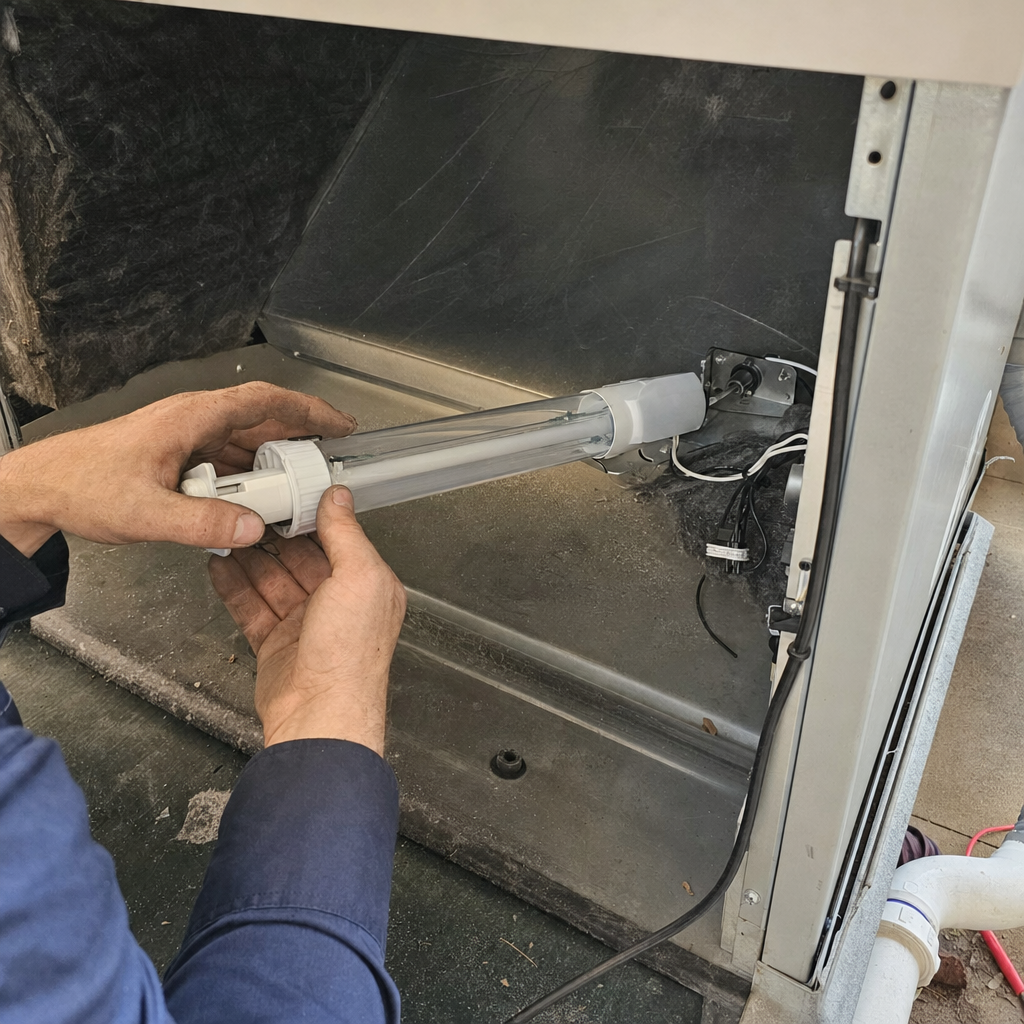
UV-C lamp installation targets the air handler and evaporator coil — the wettest, darkest point in your HVAC system where mold and bacteria proliferate during Austin’s humid summer months. We install Honeywell and Aprilaire UV systems sized to your air handler’s CFM rating, with lamp replacement schedules that account for our extended cooling season. A UV light won’t remove cedar pollen from your ducts (that’s a mechanical cleaning job), but it will suppress the mold colonies that pollen moisture feeds. Installation in Austin typically runs $450–$850 including hardware and electrical connection.
Allergen Reduction
Here’s what makes Austin different: Cedar Fever season from December through February releases Ashe juniper pollen that’s structurally unlike ordinary dust. This pollen is sticky, waxy, and electrostatically attracted to duct surfaces. Standard vacuuming won’t dislodge it — the particles adhere to metal and flex duct alike. Our allergen reduction protocol combines Rotobrush mechanical agitation with targeted sanitizing fog to break the pollen’s lipid coating and extract it from the system. For Austin homeowners, this is often a necessary annual treatment following peak cedar season, not a one-time luxury.
What happens when you call
- 1
A real person answersNo phone trees — you reach a local pro.
- 2
You get an upfront price rangeHonest numbers before anyone is dispatched.
- 3
A background-checked tech heads outLicensed & insured, dispatched right away.
- 4
You approve before work beginsNothing starts until you say go.
Trusted Brands We Service in Austin
We stock Honeywell media air cleaners and Aprilaire whole-home purifiers for Austin installations, with replacement filters available without the multi-week wait times that plague special orders. Our sanitizing fleet runs Rotobrush brush-and-vac systems and Nikro HEPA-negative-air machines — the same equipment commercial restoration contractors deploy, not consumer-grade shop vacs with HEPA stickers. For UV installations, we specify Honeywell and Aprilaire lamps with documented kill rates and proper ballast matching. When your system needs a part, we don’t disappear for two weeks; we carry the inventory to finish Austin jobs in one trip.
Common Air Quality & Sanitizing Problems We See in Austin Homes
- Cedar pollen accumulation in a waxy, adhesive layer. Ashe juniper pollen from December through February coats duct interiors with a substance standard vacuuming cannot remove. It requires chemical sanitizing to break the lipid bond and mechanical agitation to extract. We see this throughout 78704, 78702, and any home pulling Hill Country air during pollen season.
- Flex duct liner degradation from attic thermal stress. Austin attics exceed 150°F regularly in summer, softening adhesive bonds and creating micro-tears in flex duct. Debris and moisture collect in these tears, spawning mold colonies that demand professional mold treatment — not DIY bleach spray that misses the root growth.
- Sub-slab duct cracks from expansive clay soil movement. Unique to Austin’s belt of mid-century slab construction, these cracks admit groundwater, soil gases, and root moisture. The result is persistent musty odor and bacterial contamination that odor removal and bacteria sanitizing must address before any sealing work.
- Condensation on duct surfaces during humid summer months. Gulf moisture arrives June through September, and unconditioned Austin attics create dew-point conditions on cool duct exteriors. This sustained dampness feeds mold growth on liner surfaces that standard cleaning misses without borescope verification.
Pricing for Air Quality & Sanitizing in Austin, TX
Austin’s market runs slightly above Texas averages due to housing complexity and seasonal demand spikes during Cedar Fever and peak summer. Here’s what we typically quote:
| Service | Typical Range |
|---|---|
| Bacteria sanitizing (standard residential) | $275–$450 |
| Mold treatment with mechanical extraction | $350–$725 |
| Odor removal (source-traced and treated) | $275–$550 |
| UV light installation (Honeywell/Aprilaire) | $450–$850 |
| Allergen reduction post-Cedar-Fever | $325–$600 |
| Combined sanitizing + duct cleaning package | $550–$950 |
Factors that move your quote: home size and duct run length, contamination severity confirmed by borescope, accessibility (crawl space vs. attic vs. sub-slab), and whether we’re treating a standalone issue or a system-wide problem. We inspect before we quote — no estimates based on square footage alone. Call (844) 886-2161 for a free, no-obligation assessment.
We Also Serve Cities Near Austin
Our service radius covers Hornsby Bend to the east, Anderson Mill and Jollyville to the northwest, and Wells Branch to the north — the same Hill Country pollen patterns and clay soil conditions apply throughout this corridor. If you’re in these communities and noticing allergy symptoms, musty duct odors, or reduced airflow, we schedule same-week and treat your system with the same protocol we apply in Austin proper.
Serving Austin, TX — Our Local Coverage Area
We’re based in the Austin area and know this community well. Use the map below to see our service coverage — if you’re nearby, we can almost certainly help.
FAQs — Air Quality & Sanitizing in Austin
Cedar pollen is coated with a sticky, waxy lipid layer that electrostatically adheres to metal and flex duct surfaces, making it impossible to remove with standard vacuuming alone. Standard dust settles and can be extracted; cedar pollen bonds to the substrate and requires chemical sanitizing agents to break that bond before mechanical agitation can remove it. If your system ran through December through February without post-season cleaning, you likely have active pollen reservoirs circulating. Call (844) 886-2161 — we’ll borescope your ducts and show you exactly what’s in there.
Yes, sub-slab ducts can be sanitized, but the treatment must address both biological contamination and the structural failure allowing it in. We fog bacteria sanitizing agents through the compromised supply paths, then evaluate whether sealing, rerouting, or encapsulation is the durable solution for your specific crack pattern. The clay soil movement in East Austin is ongoing, so sanitizing without addressing the entry path is temporary at best. Michael Brown inspects these systems personally — he knows what 78702 slab construction looks like and won’t quote a band-aid fix.
No — UV-C lamps target mold and bacteria on wet coil surfaces, not particulate pollen suspended in or settled on ductwork. For cedar pollen, you need mechanical extraction with brush agitation and sanitizing treatment. Where UV helps in Austin is suppressing the mold colonies that thrive on summer humidity and can colonize the organic debris that pollen carries into your system. We install Honeywell and Aprilaire UV systems as part of comprehensive air quality strategies, not as pollen solutions. Call (844) 886-2161 and we’ll design the right combination for your actual contamination profile.
For whole-home integration with existing HVAC, we specify Honeywell and Aprilaire media air cleaners with MERV 13-plus filtration and adequate CFM matching — these handle the particle load Austin’s extended pollen seasons generate without choking airflow. Portable units can’t match the air volume or duct integration. The “best” brand depends on your system’s specifications, not marketing claims; we size and install based on measured static pressure and blower capacity, not box-store recommendations.
Musty post-summer odors in 78704 typically indicate mold growth on duct liner degraded by attic heat or bacterial contamination in sub-slab cracks admitting moisture. South Austin’s slab-foundation homes from the 1950s–1970s are particularly susceptible to both failure modes. The smell intensifies when cooling season ends and residual moisture stagnates in the system. We trace the source with borescope inspection — treating the wrong origin wastes money and leaves the odor. Call (844) 886-2161 for a free inspection; we’ll identify whether you need mold treatment, bacteria sanitizing, or odor removal, and quote accordingly.
Written by Michael Brown, Owner at Summit Air Duct Cleaning Service Texas, serving Austin since 2017.